

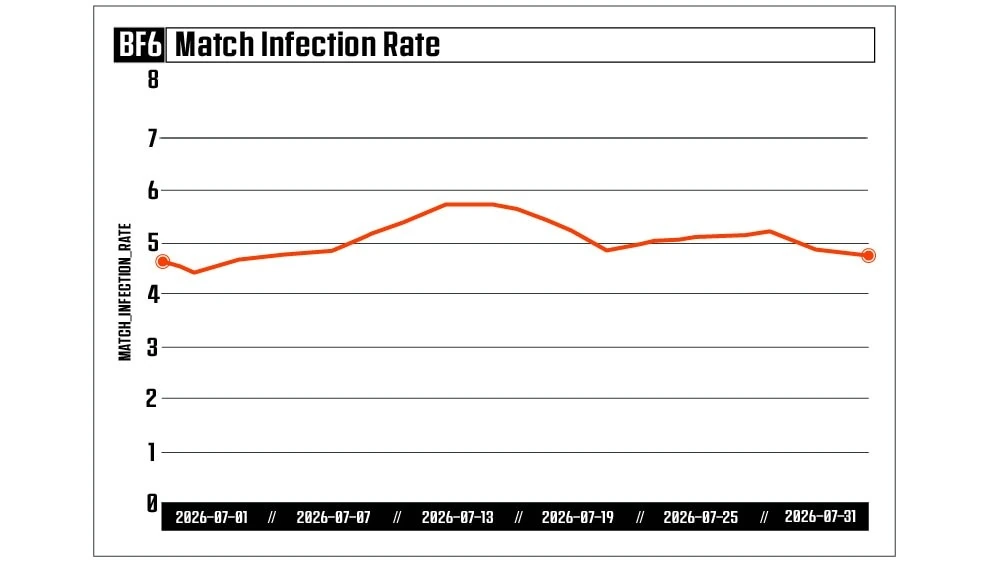
Battlefield Studios has changed the way it calculates the Match Infection Rate in Battlefield 6 after finding that reports against legitimate high-skill players, especially vehicle specialists, were making the old measure less accurate. Under the revised method, the rate ended July at 4.76 percent. EA Javelin Anti-Cheat also blocked 277,649 attempts to cheat or tamper with the game before those attempts could affect a match.
Table of Contents
The rate was corrected because reports are not proof
The Match Infection Rate counts matches believed to have been harmed by at least one cheater. Player reports are useful signals, but they can also be aimed at someone who is simply accurate, experienced or unusually effective in a tank or aircraft. EA said its analysts saw the reported rate rise without a similar change in known cheat tools or communities. That mismatch led to a review. The revised method gives less weight to accounts that receive reports over a long period, trigger no other anti-cheat signals and repeatedly pass manual checks. EA has not published the exact formula because doing so could help people design ways around it.
June provides the clearest comparison between the old and new method
The previous calculation placed the end-of-June rate at 6.59 percent. Applying the revised definition to the same period reduced that point to 4.62 percent. This does not mean a new program instantly removed almost two percentage points of cheating. It means the measurement stopped treating part of the legitimate player population as suspected offenders. Readers should therefore avoid comparing an old-method number with a new-method number as if both were produced in the same way. The useful July trend begins at the recalculated 4.62 percent reference point and follows the revised system from there.
| Measure | Confirmed July result |
|---|---|
| Match Infection Rate | 4.76 percent at the end of the measured period |
| Blocked attempts | 277,649 before they affected matches |
| Tracked cheat operations | 104 programs, devices, vendors or related groups |
| TPM 2.0 | PC enforcement active from 31 August |
July rose in the middle and then moved back down
EA reported that the revised rate climbed from 4.62 percent at the end of June to 5.74 percent between 13 and 15 July. It then fell to 4.86 percent on 20 July and continued to move during the closing part of the month, ending at 4.76 percent when the report was prepared. A daily change can reflect enforcement, player activity and the mix of modes being played. It should not be read as a direct count of banned accounts. The rate describes affected matches, so one offender can influence several sessions while a blocked attempt may never enter a match at all.
Blocked attempts and infected matches answer different questions
The figure of 277,649 covers attempts stopped before they could damage live play. The Match Infection Rate looks at matches that were negatively affected or were suspected of being affected. Combining the two into one total would be misleading because they describe different stages of protection. A high number of blocked attempts can show that prevention is active, while it can also show that many people are still trying to interfere with the game. For players, the practical point is that the prevention number should not be subtracted from reports or bans. Each measure needs its own definition and time period.
The tracked ecosystem extends beyond individual programs
EA said it was following 104 active cheat-related programs, hardware solutions, vendors, resellers and associated communities. One hundred of them were reporting failed features, detection notices, downtime or a complete shutdown of their service. The company expressed that share as 96.15 percent. This list is broader than software detected on one computer. It includes the commercial and community structure that distributes unfair tools. The count can also move when two services combine, a seller disappears or a product returns under a new name, so a lower total is not automatically the same as fewer attempts inside the game.
TPM 2.0 is now part of the PC security requirement
The report confirms that TPM 2.0 enforcement became active on 31 August. Trusted Platform Module support is a system requirement rather than an optional graphics setting. A player who receives a related launch warning should check EA’s official setup article and the computer manufacturer’s firmware instructions before changing BIOS settings. It is important to confirm whether the machine already supports TPM under another label, such as Intel PTT or AMD fTPM. Random firmware changes can prevent a system from starting, so screenshots of current settings and a recovery plan matter more than rushing through an unofficial video.